


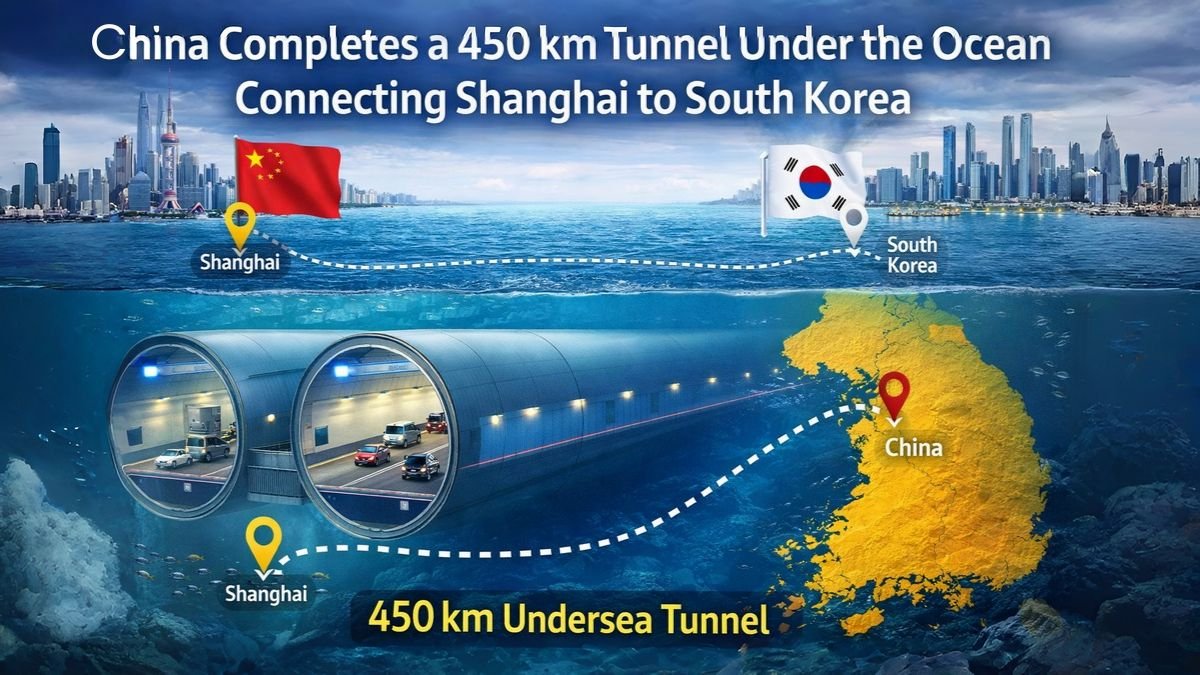
China’s Biggest Breakthrough! News stories that appear utterly shocking at first glance frequently go viral on social media. Recently, a claim has been spreading rapidly alleging that China has constructed a 450-kilometer-long undersea tunnel connecting Shanghai to South Korea. While this may sound like a remarkable feat of modern engineering and technology, the reality is quite different. According to experts and credible sources, no such massive trans-oceanic tunnel project currently exists. This claim is entirely false and misleading.
What is the real source of the viral claim?
Such stories often spread due to incomplete information or misunderstandings. Frequently, small-to-medium-scale infrastructure projects are exaggerated, leading people to believe that a monumental construction undertaking has been completed. While China has indeed constructed numerous tunnels and cross-sea link projects in recent years, none of them span a length of 450 kilometers.
Confusion Surrounding the Ningbo-Zhoushan Project
A prime example of this confusion involves the Ningbo-Zhoushan Railway Tunnel, which is reported to have a total length of approximately 77 kilometers. However, the actual undersea section of this tunnel measures only about 16 kilometers. This specific project was misrepresented on social media, giving rise to the misconception that it was a colossal 450-kilometer-long undersea tunnel—a reality far removed from the truth.
The Tunnel Beneath the Yellow River
Another project that sparked confusion is the Jinan Huanggang Tunnel. This tunnel was constructed beneath the Yellow River and spans a width of approximately 2 kilometers. Some reports claimed that it was completed in a mere 110 days; however, this detail was also misinterpreted by the public and erroneously linked to a major cross-sea infrastructure project.
The Shenzhen-Zhongshan Link: A Real, Yet Limited, Project
Another significant project in China is the Shenzhen-Zhongshan Link, a cross-sea route (comprising both above-water and undersea sections) spanning approximately 28 kilometers. While this is undoubtedly a major and significant infrastructure project, it is by no means a 450-kilometer-long tunnel of international scale. It has frequently been exaggerated, leading to increased misunderstandings.
What is the world’s longest undersea tunnel?
When it comes to the world’s longest undersea tunnel, the record is still held by the Seikan Tunnel. Located in Japan, this tunnel spans approximately 53 kilometers. From this, one can gauge just how technically and economically challenging it currently is to construct a 450-kilometer-long undersea tunnel.
China’s Current Undersea Projects
The largest undersea projects currently underway in China are primarily focused on high-speed rail and port connectivity. For instance, a tunnel currently under construction in the Zhoushan region includes an undersea section of approximately 16 kilometers. This project is being developed to link the country’s major ports with the national rail network.
Conclusion
All in all, the claim that China is constructing a 450-kilometer-long undersea tunnel is entirely false and is the result of a misconception that has spread across social media. Although China is making rapid strides in the field of infrastructure, there is no official or credible information available regarding a project of such immense scale and complexity. Therefore, one should always verify the veracity of such reports before placing any credence in them.
FAQs
Q1. Has China built a 450 km undersea tunnel?
No, this claim is false and not supported by any official records.
Q2. Where did this rumor come from?
It likely started from misinterpretation of smaller Chinese tunnel projects shared on social media.
Q3. What is the Ningbo-Zhoushan tunnel length?
It is about 77 km long, with only around 16 km under the sea.
















Leave a Reply