

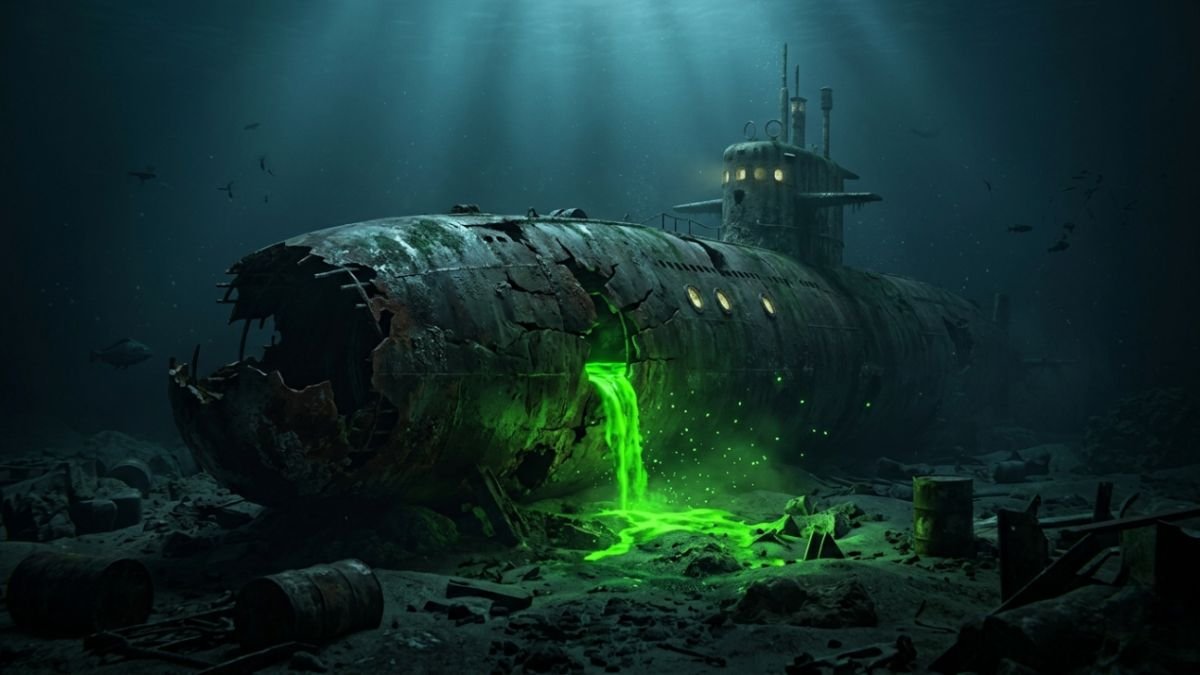
Hidden within the depths of the ocean lie many mysteries that, from time to time, surface to astonish the world. One such incident came to light in 1989, when a massive fire broke out aboard the Soviet Navy’s nuclear submarine, the Komsomolets. This event occurred in the Norwegian Sea at a depth of approximately 335 meters.
Following the outbreak of the fire, the submarine somehow managed to surface; however, the accident was so severe that out of the 69 people on board, only 27 survived. Subsequently, the submarine sank completely, and today it rests at a depth of approximately 1,680 meters—lying about 180 kilometers off the coast of Bear Island, Norway.
Presence of Nuclear Weapons Heightens Concerns
This submarine was no ordinary military vessel; rather, it was powered by a nuclear reactor. Furthermore, it is believed to have carried two nuclear weapons equipped with torpedoes. This is precisely why the vessel’s sinking has been a persistent source of concern among scientists and environmental experts ever since the incident occurred.
The greatest fear is that if radioactive materials were to leak from the submarine, they could pose a grave threat to marine life and the environment.
First Warning Emerges in 1994
A few years after the submarine sank—in 1994—a Russian expedition made a startling discovery. Investigations revealed that plutonium was leaking from one of the nuclear weapons on board. The moment this information came to light, international alarm intensified significantly.
Consequently, in 1995, efforts were undertaken to seal the cracks in the submarine’s hull and torpedo tubes in an attempt to halt the leakage. Subsequent periodic monitoring missions have indicated that, even if some leakage is occurring, the radioactive material quickly disperses within the seawater, thereby minimizing its environmental impact.
New Investigation Using Modern Technology
Recently, a team of Norwegian scientists conducted a detailed study of this submarine in 2019. The team was led by Justyna Gwiazda and Hilde Elise Heldal.
For this investigation, they utilized a state-of-the-art remote-controlled vehicle named “Ægir 6000.” This specialized device is capable of operating at depths of up to 6,000 meters and is equipped with cameras as well as various scientific instruments.
With the aid of this equipment, the scientists collected samples of seawater and sediment, which they subsequently subjected to in-depth analysis.
Is There a Leak from the Nuclear Weapons?
The scientists’ investigation revealed that samples collected near the torpedo section showed no evidence of plutonium leakage. This comes as a relief, as it indicates that the nuclear weapons currently remain in a secure state.
However, the investigation brought another significant finding to light. A leakage of radioactive material was observed in samples collected near the submarine’s ventilation pipe. This implies that the submarine’s nuclear reactor is intermittently releasing small quantities of radioactive material.
Corrosion in the Reactor Identified as the Cause
By analyzing the ratio of plutonium to uranium, the scientists concluded that the fuel within the submarine’s reactor is gradually corroding. This corrosion is the underlying reason for the periodic leakage of radioactive material.
Since this leakage is not continuous but occurs intermittently, it is being referred to as “intermittent leakage.”
Does This Pose a Threat to the Environment?
The most critical question surrounding this entire matter is whether this leakage poses a danger to marine life and the environment.
According to the scientists, despite the leakage that has occurred over the past 30 years, no significant accumulation of radioactive elements has been detected in the surrounding area. The primary reason for this is the vast volume of seawater, which rapidly dilutes these substances.
This implies that, for the time being, this leakage does not pose a major threat; however, it cannot be ignored either.
Important Lessons for the Future
Scientists view this research as a significant warning. In the present era—when military activities are on the rise globally and nuclear technology is being utilized—it is imperative to learn from such accidents.
The case of the Komsomolets submarine demonstrates that the impact of nuclear accidents occurring in the ocean can persist for a prolonged period. Therefore, to mitigate such risks in the future, enhanced safety protocols and rigorous monitoring are essential.
Conclusion
The Komsomolets submarine continues to exist today as a potential hazard within the ocean’s depths. Although its immediate impact remains limited, this incident compels us to reflect on the fact that, alongside technological advancement, safety and environmental protection are of equal importance.
This research not only uncovers the truth behind a past tragedy but also serves as a cautionary reminder for us to remain vigilant in the future.
FAQs
Q. What is the Komsomolets submarine?
A. It was a Soviet nuclear-powered submarine that sank in 1989.
Q. Where is the submarine located now?
A. It lies about 1680 meters deep in the Norwegian Sea.
Q. Is the submarine leaking radioactive material?
A. Yes, small amounts are leaking intermittently from the reactor.
Q. Are nuclear weapons on board leaking?
A. No, there is no evidence of leakage from the nuclear warheads.
Q. Is the leakage dangerous to the environment?
A. Currently, the impact is limited due to dilution in seawater.








Leave a Reply